Glute guide
How to grow glutes: what the science says
Your glutes grow with strength training: 10 or more hard sets a week, with moves like the hip thrust and the squat, each set ending close to failure. Strength goes up in the first weeks, and your body changes over months.
- 10+hard sets a week for your glutes
- 2 to 3glute and leg days a week
- 1 to 3reps left in reserve at the end of each set
What makes glutes grow
Your glutes are muscles like any other: they grow when you challenge them with enough hard sets, week after week, and give them time and food to recover.
Women build muscle at the same relative rate as men: a 2025 meta-analysis of 29 studies found no real difference in relative gains. The rules of training are the same; your plan adapts to you.
Three studies, side by side
Who took part, what was measured and what changed.
Plotkin 2023
- Who
- 34 young adults new to lifting, 9 weeks, 15 to 17 supervised sessions.
- Measured
- Muscle size by MRI, after the same number of sets of hip thrusts or back squats.
- Found
- The glutes grew about the same in both groups. The squat grew the quads and the adductors more. The gluteus medius and minimus barely grew in either.
Barbalho 2020
- Who
- 22 trained women, 12 weeks.
- Measured
- Muscle thickness by ultrasound, back squat or hip thrust.
- Found
- Gluteus maximus: +9.4% with the squat and +3.7% with the hip thrust. Quads: +12.2% and +2%. Both groups raised their hip thrust max.
Kassiano 2023 Preprint, not yet peer reviewed
- Who
- 33 young women new to lifting, 10 weeks, 3 times a week.
- Measured
- Gluteus maximus thickness by ultrasound.
- Found
- Adding the barbell hip thrust to the leg press and the stiff-leg deadlift grew the gluteus maximus more than those two alone.
The two trials that pit the squat against the hip thrust disagree on which one wins. Both grew the glutes, so the safe bet is to use both in the same plan.
The exercises that work
Build each glute day from a few families of moves: a hip thrust or a bridge, a squat or a lunge, a hip hinge, and an abduction for the side of your hips.
Barbell hip thrust
Hip thrust
Barbell back squat
Squat
Dumbbell Bulgarian split squat
Split squat
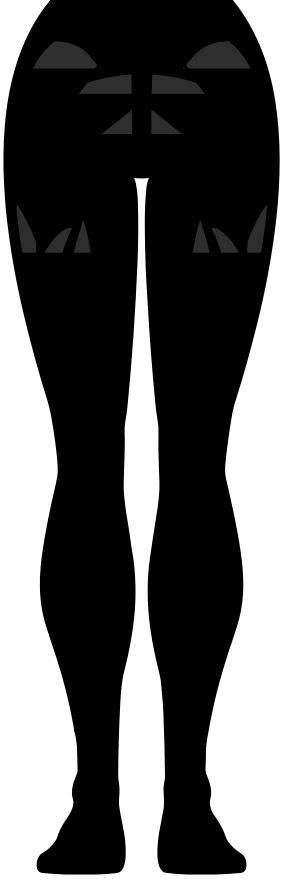
Barbell Romanian deadlift
Hip hinge
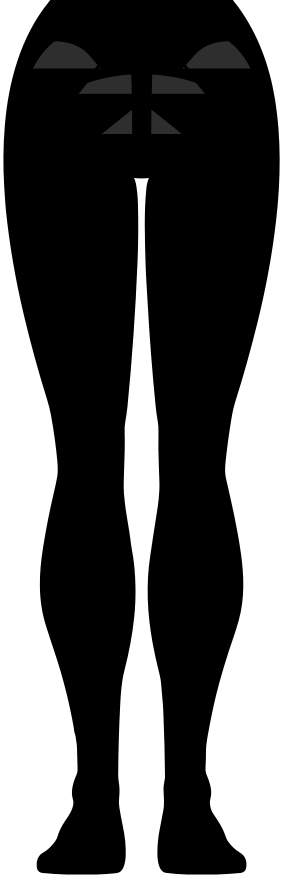
Hip abduction machine
Abduction
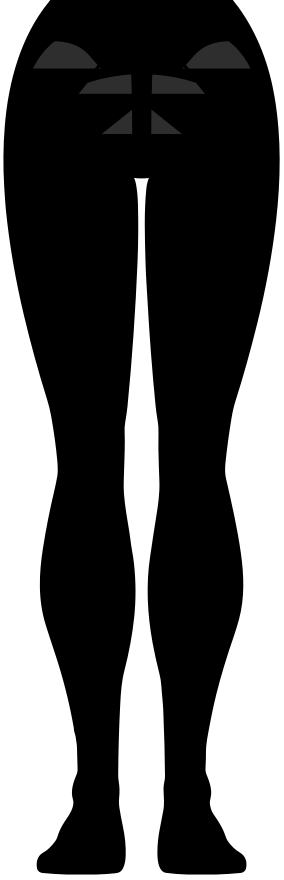
Glute bridge
At home
How many sets and how often
The 2026 position stand of the American College of Sports Medicine, an overview of 137 systematic reviews, found that 10 or more sets per muscle per week grow more muscle, and that light and heavy weights both work when each set ends close to failure.
In the app, glute volume starts around 10 sets a week and goes up phase by phase, over 2 to 3 glute and leg days. Each set ends with 1 to 3 reps in reserve: you stop while you could still do a few more with good form.
Do you need to feel your glutes?
Feeling the muscle helps you learn the move, but it is not what makes it grow. In the 9-week trial, the hip thrust showed more glute activity than the squat in the first session, and that did not predict who grew more. Load, sets and consistency do.
More glutes, less thigh
If you want your glutes to grow more than your thighs, lean on hip thrusts, bridges and abductions, and keep deep squats lower in the plan. The hip thrust still works the thighs a little: in the trial with trained women, the quads grew 2% with it and 12.2% with the squat.
How long it takes
Strength goes up in the first weeks, while you learn the moves. Your body changes over months, with load, sets and consistency. The three studies above lasted 9, 10 and 12 weeks.
That is why the app logs every set from your first workout, so you can follow your strength week by week.
What training cannot promise
Some promises sell well, and the studies do not back them. Here is what the evidence says instead.
The promise
Losing fat from just your butt or thighs
Fat comes off the whole body, not from the muscle you train. A meta-analysis of 13 studies with 1,158 people found that training one area did not reduce the fat on that area.
What is true
Fat comes off the whole body. The glute muscle underneath grows and gets stronger.
The promise
Getting rid of cellulite
80% to 90% of women have cellulite, mostly on the thighs, buttocks and hips. Fibrous bands under the skin play a central role, and a review of 67 studies found no clear evidence that any treatment works well.
What is true
Cellulite is part of the skin, and almost every woman has it. Training works the muscle under it.
The promise
Fixing hip dips
Hip dips are the inward curve on the side of the hips, next to the top of the thigh bone. They follow the shape of your bones and muscles: a 2024 paper lists athletic muscle definition and aging among the causes. No study we read showed training changing them, and in the 9-week trial the gluteus medius barely grew.
What is true
Hip dips are the shape of your hips, and many athletes have them. Training makes the side of your hips strong.
The promise
Growing your glutes without growing your thighs
The squat grows the quads more than the hip thrust, but the hip thrust still grows them a little: +2% in the trial with trained women.
What is true
You can focus on your glutes: more hip thrusts and abductions, fewer deep squats.
Protein
Muscle needs protein to grow. For people who exercise, the International Society of Sports Nutrition suggests 1.4 to 2.0 g of protein per kg of body weight a day.
Booty day. Let’s lift that number.
Turn this into your 12-week glute plan
The app builds the plan for you: 2 to 3 glute and leg days a week, the weight for each set, and a booty map that fills up as you train.
Sources
Currier 2026
Currier BS, D'Souza AC, et al. American College of Sports Medicine Position Stand. Resistance Training Prescription for Muscle Function, Hypertrophy, and Physical Performance in Healthy Adults: An Overview of Reviews. Med Sci Sports Exerc. 2026;58(4):851-872.
Refalo 2025
Refalo MC, et al. Sex differences in absolute and relative changes in muscle size following resistance training. PeerJ. 2025;13:e19042.
Plotkin 2023
Plotkin DL, Rodas MA, et al. Hip thrust and back squat training elicit similar gluteus muscle hypertrophy and transfer similarly to the deadlift. Front Physiol. 2023;14:1279170.
Barbalho 2020
Barbalho M, Coswig V, et al. Back Squat vs. Hip Thrust Resistance-training Programs in Well-trained Women. Int J Sports Med. 2020;41(5):306-310.
Kassiano 2023
Kassiano W, et al. Addition of the barbell hip thrust is effective for enhancing gluteus maximus hypertrophy in young women. Research Square. 2023 (preprint).
Ramirez-Campillo 2022
Ramirez-Campillo R, et al. A proposed model to test the hypothesis of exercise-induced localized fat reduction (spot reduction), including a systematic review with meta-analysis. Human Movement. 2022;23(3):1-14.
Gabriel 2023
Gabriel A, et al. Cellulite: Current Understanding and Treatment. Aesthet Surg J Open Forum. 2023.
Luebberding 2015
Luebberding S, Krueger N, Sadick NS. Cellulite: an evidence-based review. Am J Clin Dermatol. 2015.
Bass 2020
Bass LS, Kaminer MS. Insights Into the Pathophysiology of Cellulite: A Review. Dermatol Surg. 2020.
Lourenco 2024
Lourenco L, et al. Hip dips technique: Filling lateral depressions with hyaluronic acid of large particles. Skin Health Dis. 2024.
Jäger 2017
Jäger R, Kerksick CM, Campbell BI, et al. International Society of Sports Nutrition Position Stand: protein and exercise. J Int Soc Sports Nutr. 2017;14:20.
Review
Draft. This guide is waiting for review by a certified strength and conditioning professional.
Updated October 31, 2026